

By Vantarix | AI Automation for Service Businesses
If you’re running a home service business, your day probably looks something like this: you’re out on a job, your phone is blowing up, you’ve got estimates to send, a customer who hasn’t paid, and three people who said they’d “think about it” last week and never called back.
None of that is the actual work. It’s the admin work around the work — and it’s eating your time, your energy, and your revenue.
The good news is that most of it can be automated. Not outsourced. Not delegated. Automated — meaning a system handles it while you’re focused on the job.
Here are the five tasks that waste the most time for small service businesses, and exactly how AI automation fixes each one.
1. Missed Call Follow-Ups
Time wasted weekly: 2-4 hours of lost revenue opportunity
Every missed call is a potential job walking out the door. Most customers don’t leave voicemails — they just call the next contractor on Google.
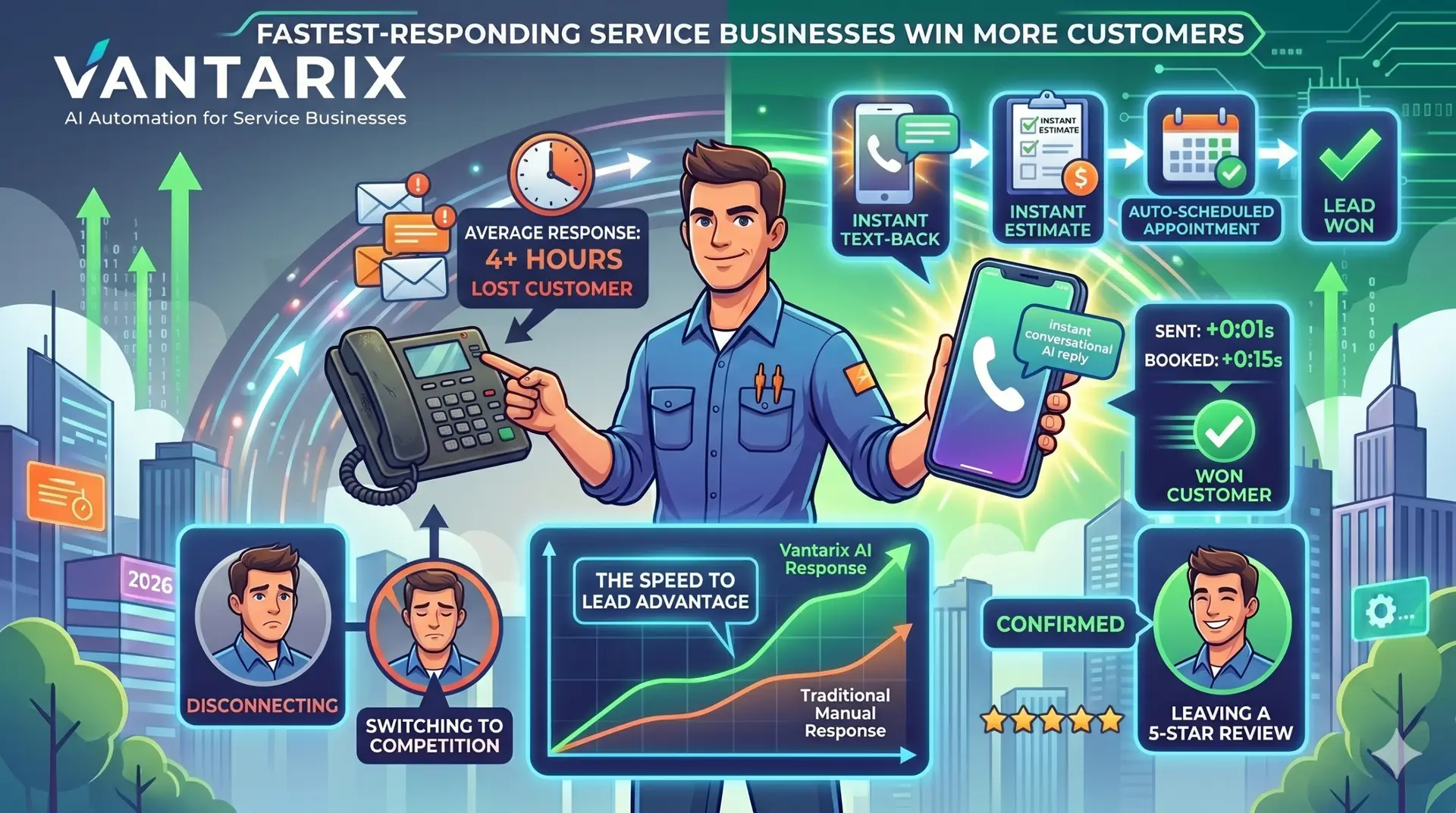
AI missed-call text-back changes that. The moment someone calls and doesn’t get an answer, an automated message goes out within seconds, opening a conversation and keeping the lead warm until you can respond.
What happens without automation: Lead calls, gets voicemail, hangs up, calls your competitor. You never know they existed.
What happens with automation: Lead calls, gets an instant text, responds, gets qualified — all before you’ve finished the job you’re on.
This is one of the highest-ROI automations available to any service business. The setup is simple. The payoff is immediate.
2. Appointment Reminders
Time wasted weekly: 1-3 hours chasing confirmations and no-shows
No-shows are expensive. A missed estimate appointment means wasted drive time, a hole in your schedule, and a lead that’s now cold. For businesses running on tight schedules, even one no-show a week adds up fast.
Manual reminder calls take time you don’t have. Texts sent from your personal number look unprofessional and are easy to ignore.
Automated appointment reminders solve this cleanly:
- 24 hours before: Reminder text with appointment details
- 2 hours before: Final confirmation with option to reschedule
- Post-appointment: Automatic follow-up to keep the relationship warm
Businesses that implement automated reminders typically see no-show rates drop by 30-50%. That’s real money back in your schedule.
3. Review Requests
Time wasted weekly: Inconsistent or never done
Online reviews are the single most powerful sales tool a local service business has. A roofing company with 200 five-star reviews will win against a competitor with 40 every single time — regardless of price.
But most business owners forget to ask. Or they mean to ask, but the job ends, they move on, and the happy customer never posts anything.
Automated review requests fix this permanently. When a job is marked complete, the system automatically sends the customer a text asking them to leave a Google review. No effort required on your end.
The timing matters too. Asking within 24 hours of a completed job — when the customer is still happy and the experience is fresh — dramatically increases the response rate compared to asking days or weeks later.
The compounding effect: Three new reviews a week is 150 reviews a year. Over two years, you’re the most reviewed contractor in your market. That reputation builds itself.
4. Lead Qualification
Time wasted weekly: 2-5 hours on calls that go nowhere
Not every lead is a good lead. Some people are just price shopping. Some want a job that’s outside your service area. Some have a $200 budget for a $2,000 job.
Talking to every single one of them manually is exhausting and unproductive. AI lead qualification handles the initial screening for you.
When a new lead comes in — from your website, a Facebook ad, a Google listing — an automated AI conversation starts immediately. It asks the right questions:
- What’s the job?
- Where is the property located?
- What’s the timeline?
- Have you gotten other estimates?
By the time you see the lead, you already know if it’s worth your time. You’re not making discovery calls — you’re making closing calls.
For businesses running paid ads, this is especially valuable. You’re paying for every click. Automated lead qualification makes sure you’re only spending your time on the ones worth pursuing.
5. Estimate Follow-Ups
Time wasted weekly: Inconsistent, often forgotten entirely
You sent the estimate. Three days passed. Nothing.
Most contractors either give up at this point or make one awkward call and then let it go. The job often goes to whoever follows up most persistently — and that’s rarely the best contractor. It’s just the most organized one.
Automated estimate follow-up sequences solve this without any effort:
- Day 1 after estimate: “Hey [Name], just wanted to make sure you received our estimate. Any questions I can answer?”
- Day 3: “We’ve got some availability opening up next week — wanted to check in before it fills up.”
- Day 7: “Last follow-up from us — happy to adjust the scope if budget is a factor. Just let me know.”
These messages go out automatically. You don’t have to remember. You don’t have to feel awkward. And the conversion rate on followed-up estimates is dramatically higher than on abandoned ones.
The Bigger Picture: You’re Not Replacing People — You’re Eliminating Busywork
Here’s what automation is not: it’s not a replacement for good work, good relationships, or a skilled team.
What it is: a system that handles the repetitive, administrative, follow-up work that nobody likes doing — and that falls through the cracks constantly in a busy service business.
Every hour your team spends manually texting reminders, chasing leads, and asking for reviews is an hour they’re not doing revenue-generating work. Automation gives that time back.
The businesses that win in 2026 aren’t necessarily the ones with the best crews or the lowest prices. They’re the ones with the best systems — because systems scale, and hustle doesn’t.
Vantarix helps service businesses automate these five systems without hiring more staff — and without turning into a tech company to do it.